This will be part one of two planning posts about how our project will use mise-en-scene. The term "mise-en-scene" is a little vague, since it is actually many different aspects of production. It includes how lighting is used, the different costumes, the set design, the props, the overall color scheme, etc. This is most likely why we have to split this planning post into two sections. This post will talk about location, lighting, and set design. So let's start with location.
Location
The location will be relatively simple. At first, we didn't really know what a therapist's office looked like. We kind of thought it would be in an office building of some sort, and look more corporate. We even started to brainstorm on possibly renting out an office room to shoot at, but before going that far we decided to actually do research. After doing a little looking around with an underground niche searching tool called Google, we realized it is not really like that at all. A therapist's office looks surprisingly casual, yet still decently professional. It is not the corporate office like we had originally thought, and we realized we could probably just shoot it at one of our houses.
Here are some images I found after a quick search.
Therapist's offices are still usually in office buildings, but for this type of room, I think it is safe to film at one of our houses. All we would need to do is prepare the room to make it neat and rearrange the chairs/couch in a way that fits the layouts that I found. The setting pf the film would still be an office building, so that would be implied when the assistant walks in (because who would have an assistant just chilling in their house). When Alice goes to her car at the end of the first part, that would likely be filmed at some sort of public plaza parking lot near one of us. This would also keep the allusion that she was at an office building.
Lighting
For the lighting, I think our film should be pretty bright. I think this really could add to our character's anxiety and overstimulation.
I don't know about you, but the top image would be a better catalyst for stress for me than the bottom one.
Whenever I go to some giant shopping center and they have insanely bright lights on it sometimes makes me anxious and feel like I need to escape. Is that just me? Yeah? Alright moving on...
One of our members is in TV production, so she has a decent light at home. We can also just use the normal house lights, and if it doesn't end up looking good we'll just fix it in post. If it looks unfixable, we might just go for more of a medium brightness. Or maybe we make it bright but dim it slightly in post. I don't really know, I just don't want it to look dark because that would make the film feel calmer and somber when I want to go for more of a stressful feel. We will probably talk about this in class tomorrow to straighten things out. Lighting is hard when you don't have a giant professional budget, but I feel that we will make it work in the end.
Set Design
Ok, set design is really important. First of all, we want it to look like an actual therapist's office. I already kind of touched on that in the location section. The main thing, though, is maintaining continuity. This is a time loop film, so in every loop, the items on desks and shelves have to be exactly as they were before. The same thing with furniture, they can't shift even a little bit since that will break continuity. Also, we need to maintain the lighting exactly the same each time we loop. Everything within the room needs to stay the same for every loop. This was a big talking point when we first met with our teacher to discuss the idea.
We also want the room to be more neutral in the color scheme. So whites, greys, blacks, beiges, those types of colors. It will make the room feel more corporate and professional, even though the actual chairs and couch are more casual individually. This is for us to make the audience feel the artificiality of the therapist, and how she doesn't really care that much about Alice. This feeling of artificiality and apathy is also what Alice will pick up on throughout the session, and we will see her feel isolated with some of our shots. One idea of a shot I had is when the assistant interrupts, it will be a medium/long focused on Alice in the background, while the foreground is the assistant and the therapist blurred out while slightly obstructing her. This will add to the sense of isolation Alice feels from the people around her, and will act as a starting point for her character development.
Alright, that is enough yap for today. I will post the second part tomorrow, which will focus on costumes and props.
Sources:
- Therapy Rooms - The Matlock Therapy Centre. (2023, May 31). The Matlock Therapy Centre. https://www.matlocktherapycentre.co.uk/therapy-rooms/
- Gale, J. (2022, July 21).Inside 12 Therapy Rooms. The Psychosynthesis Centre. https://psychosynthesis.online/inside-12-therapy-rooms/
- Vandervort, M. (2025, February).Fun Furniture Living Room. Pinterest. https://www.pinterest.com/pin/961448220453717448/
- CARPETS. (2025, January 29).Apartment Decor Green Couch. Pinterest. https://www.pinterest.com/pin/1086915691323488451/
Today we worked on actual dialogue and the script for our project. We figured out a little bit more of who our protagonist is, and how she interacts with others. We also figured out how other characters will act within our film opening, which is really only the therapist, the mysterious caller, and an assistant that isn't really important. Since figuring out our protagonist was such a significant theme discussed in today's class, I figured that is the blog topic I would post about for today.
Meet Alice
Before I say anything, we came up with her name on our own, and it just happened to be the name of one of the example post's characters. And it is funny because another character we came up with ALSO happened to have the same name as another character from the SAME POST. I swear I can never have an original thought. Anyways, back to the actual topic of the post. Our main protagonist's name is Alice, which was inspired by the story of Alice in Wonderland which also just so happens to be the inspiration behind the example poster's character name, because of course. We went with this because of the bizarre circumstances our protagonist is going through with the whole time loop and everything. She isn't perfect and definitely has some issues that need sorting out, so let's talk about them. For one, she has depression and anxiety, so she needs to take antidepressants which will show up in our opening scene. Today in class we thought the reason she could be in therapy was that she had maybe attempted suicide or something and was court-ordered to have therapy. She also has a bad relationship with her mother, possibly an abusive one. We also want her aesthetic to look kind of grungy. A perfect example of someone with the aesthetic I am talking about is Jane from Breaking Bad (2008).
Here is some images of her I found so you see what I am talking about.
I was thinking she would wear grey or darker-shaded colors. I also don't think she should have too much makeup since she wouldn't really care about that kind of stuff. Her development will focus on overcoming her trauma or her mental health in some way. We don't want her to be too emo, but want her to be annoyed that she has to do therapy. This will make her more quiet and slightly rude when the therapist is trying to talk with her. Oh yeah, I almost forgot. The therapist!
The Rest of the Cast
The therapist's name will be Dr. Schultz. We didn't have any inspiration for this, I just kind of came up with it. We want her to kind of act like she doesn't care about Alice, but is still being professional about her job. She asks very ordinary therapist-esque questions to her and only gets enthusiastic when she thinks she has some sort of breakthrough that will boost her ego. While making the script, we thought it could be funny to have Alice say "Why am I here again? We just did this! ", after the first loop occurs and then have Schultz respond "I know it may seem redundant at first, but the more sessions we have the more progress we’ll make." We didn't really make Schultz's character development too deep, since she is stuck on repeat each loop, so she is a static character.
We also decided to have Schultz's assistant interrupt the session to deliver some files. This would act as one of the motifs that happens in each loop. We decided to name the assistant T. Jacobs, which is a homage to Texas Jacobs, the lead singer of our music video project. Since I played Texas Jacobs, I am going to play T. Jacobs in this opening to keep it consistent. The only time his name would pop up is on a name sticker he has since he is just an assistant intern. We also want him to have a relaxed demeanor, but his character doesn't really matter that much since he only shows up for a few seconds each loop. Oh and guess what. Of course, the example had another character named Jacob in their post. The coincidences are diabolical.
Finally, we have the mysterious phone caller who triggers the loop. We haven't really thought about who they are, but we know how they act. They will act pretty sinister and cocky every time they contact Alice, clearly taking pleasure in her misfortune. Their first line is "You should have answered the first time.." and their second line is "At least finish the session first." These all give this caller a villain persona and will keep the plot interesting since they are the only other character that acts differently in each loop, making them dynamic. They will taunt Alice throughout the film, and we thought that maybe (if it was an actual film) eventually they would be revealed to be Alice's mom. The whole thing also could have been a psychotic break from Alice's past trauma, but let's just focus on the opening before trying to figure out all of that stuff. The key to stopping the loop will lie with them.
Sources:
- Guisinger, J. (2024, December 31).Jane Margolis Hair. Pinterest. https://www.pinterest.com/pin/387309636722510523/
- jane margolis. (2022). Pinterest. https://www.pinterest.com/pin/702139398188878942/
Audio. It is an integral part of media. Without it, the experience one has with a film/show/game/whatever will be noticeably dampened. Take horror movies, for example. Audio is really the most important thing for them because, without it, they simply aren't scary anymore.
Go ahead and watch this iconic jump scare scene in Jaws (1975) with full audio, and then without.
There is a noticeable difference in how bad that jump scare gets you. Without that violin screech sound effect, it is just a corpse awkwardly floating out towards him. When I was watching Hereditary (2018) on my computer with headphones on, I got so scared near the end that my only remedy was to turn down the audio. That definitely helped me get through that insanely terrifying last part, because if I had my audio up, it would have been ten times worse. The sound design and score of that movie were really something else, and I even talked about it in a previous post. It really felt like the audio was where 80% of my fear originated from. Here is a link to an interesting article I found that explains a little bit about the psychology of this phenomenon.
But enough about horror movies, this is a planning post for audio in our film opening project. The audio to this opening is extremely important since it can also be used to convey our protagonist's feelings effectively. I imagine the audio as causing genuine stress for her through normal background ambiance, or a quiet soundtrack. Hereditary did something similar to this for most of the movie, building up suspense and dread in the viewer subconsciously that something will go wrong (It, in fact, did go wrong). Ok, I'll stop talking about Hereditary now. Anyways, since this opening is based on a time loop, naturally we want to emphasize time. We could do this by starting the film off with the clock ticking in the therapist's office as the title card is revealed. I'll admit, this is inspired by Back To The Future (1985), which is actually one of the openings that I researched.We will make ours original though, so just hear me out.
We hear clocks before any imagery is shown from the actual film, immediately establishing the plot.
What will differentiate our opening from this, is how the sound is used to convey emotion. We want it to be just a normal clock ticking, not a bunch ticking over each other. I also want to add a faint build-up sound effect before the first shot is finally shown, emphasizing the stress our protagonist is about to go through. Then bam, we are hit with a close-up of our character zoning out. You know that shot in Breaking Bad (2008) where Walter White finds out he has cancer?
This one.
I want our opening shot to be similar to this, except our protagonist is really just zoning out. The audio that builds up to that will really set the tone for this film's opening. Then throughout the scene, the clock will stay ticking throughout. That is, until our character leaves the office and walks to her car, where for the first time there is silence. Maybe some cars in the distance or birds chirping, but generally quiet, peaceful ambiance. Then the whole phone call thing happens, and she loops. Once she loops back, however, the ticking will resume now that she is back in the office, emphasizing her stress with the situation and the whole fact that it is a time loop. We also want her to loop back to when the therapist asks her "So how does that make you feel?". It will signify the loop occurring and also can have double meaning since it is almost like the therapist is asking how she feels about herself being stuck in the loop. That questioning is also another audio layer over the ticking which can add to the overstimulation of the situation. The phone's sound effects where it is hanging up, and also when it calls, can also add to the stress. On top of that, once the loop has occurred, we can add a subtle tense soundtrack in the background as the scene unveils.
These audio effects are easy to mess up and make the scene feel too chaotic, however. We need a good balance that conveys the feeling we want to portray without it feeling poorly edited together. That is the art of audio design. When editing, you really just have to keep listening to it over and over again and tweak a few things each time to perfect it. This is something I am willing to do when it comes to this project because audio is such an integral part of filmmaking. I have a lot of faith in this project, and truly believe it can become something great if we execute it properly.
Sources:
- Fear: The Home Of Horror. (2020, August 27).Hooper Discovers Ben Gardner’s Boat | JAWS (1975). YouTube. https://www.youtube.com/watch?v=XDs5a0BcEzY
- Clasen, M. (2022, September 17).Without Sound, Horror Movies Just Aren’t Scary | Psychology Today. Www.psychologytoday.com. https://www.psychologytoday.com/us/blog/why-we-love-horror/202209/without-sound-horror-movies-just-arent-scary
- MovieTitleScreens. (2012). Back To The Future 1985 -- OPENING TITLE SEQUENCE. InYouTube. https://www.youtube.com/watch?v=3isQI0nXQRE
- Reddit - Dive into anything. (2019). Reddit.com. https://www.reddit.com/r/shittymoviedetails/comments/aiuyhn/in_breaking_bad_20082013_the_main_character/ (Where I got the Walter picture)
After that sort of convoluted plot post, we now had to do the storyboard. We started it last class, and today it is finally finished and contains a good idea of where the plot will go for this two-minute opening. The storyboard will give a good visual as to what our project will actually look like. The main point of storyboards is to help guide us when filming, so we aren't confused about what we have or haven't shot yet. It acts as a kind of checklist, almost, and gives structure to the filming process. It is also nice to just have a plan written out on paper for us to always refer back to instead of ideas floating around in our heads during production. All of that will keep production quick and efficient when we finally start filming.
Here is the storyboard below:
In the case that this does not fill up two minutes, we are thinking about adding another scene. This would be her sitting through the session again really homing in on the things in the room that have occurred exactly the same way, like the time being how it was before, or an assistant walking in and interrupting. These would be things that happened the first time the session played out, but now they are emphasized since they are happening again in the exact same way they happened before, and our protagonist is freaking out by it. The extra scene would end up with her getting in her car again, but this time she calls the number instead of it calling her, and that's when our opening would end. The reason we did not write that out on the storyboard is because we think that would make it too long, since we are only allotted two minutes to do this thing. This idea will always be there for us if in the case that we need the extra time. It is always better to have too much than to have too little. I am really excited to see how this project turns out, and I will see you next week with some more posts!
It is finally time to talk about the plot. Today in class our group discussed the plot heavily and really tried to reach a consensus since we all had different ideas. The main dilemma in this discussion was if the protagonist knew she was in a time loop already, or if she found out in the opening. We discussed the pros and cons of each approach, but finally decided that her finding out about the loop makes the most sense if we are thinking of the project like it is a start to an actual film. Our ideas were too complex for a two-minute opening, and we realized we were trying to do some crazy plot twists and stuff that would happen later on if it was a full feature-length film. This project is about making a film OPENING, so we needed to think about it like the start of an actual movie. Most of the issues were from that, but then we had another issue, which was how we would establish the loop.
The loop was really confusing to try and solve, but I think we did it. It was hard to establish the loop without it looking like a mistake, or ending up being confusing. In the early days of our conceptualization, we thought that the opening would be the whole therapy session, and then at the very end, we would have the loop occur. Then, we met with our teacher who said it could look like a mistake, so we decided to structure it differently. This is going to sound a little confusing at first but bear with me. We decided that the opening would start with the end of the therapy session, then our character loops, and the main part would be the whole therapy session before looping back to the start at the end. Wow, that probably didn't make any sense, so I am just going to draw a diagram to make it clearer.
To decipher this terrible diagram, EOS means the end of the therapy session, and SOS means the start of the therapy session. The lines indicate the loop occurring.
The issue with this structure really came down to us trying to fit a whole therapy session in two minutes, so we brainstormed for another structure that would give us enough time to take our time with the plot, if you get what I'm trying to say. We then finally decided on a loop that would work for a two-minute opening like this, which would feel more natural since therapy sessions don't really last two minutes in real life. Here is yet another terrible diagram to attempt to help you understand what we are trying to do here.
The line marks the beginning of our opening. The dots represent phone calls. The arrow shows where we are looping back to, which is the first phone call.
Now you're probably wondering where the phone calls came from, so let me explain the plot which is really the whole point of this post in the first place. We want our character to have some sort of family trauma, and talk about it with the therapist. This will help establish our character, which is the approach of our opening. The conflict of our project would originate from a mysterious caller. Midway through the therapy session, our protagonist would get a call from a random number and dismiss it since she is in the middle of her therapy session. Once finishing up the therapy session, she would walk to her car and sit down. This is when she gets another call from the same number, so she picks it up this time. The caller would say something along the lines of "You should have picked up the first time", where she will then loop back to when the first phone call was dismissed. She will realize that she just traveled back in time, and that would begin to freak out (because who wouldn't) which will most likely be around the end of our opening.
If this was a real film, then the plot would be her trying to find out who this mysterious caller is and how she could break the loop, where she would loop back every time she got that second call. We discussed how she might be able to break the loop, and we thought maybe she needs to solve her trauma with her family and move on, before actually being able to move on time-wise. We also were trying to decide who the caller would be. It could be one of her parents, or maybe even the therapist, we just haven't really decided yet. We think this is a really cool idea, and are working on the storyboard right now, which I will post about either tomorrow or the next day. I hope this wasn't the most confusing plot ever, and apologize for my diagrams.
For this post, I will talk about a media theory I wish to integrate into my project. The media theory I chose is Todorov's Narrative Theory of Equilibrium. I believe it fits the project best since we are introduced to our character and then the time loop begins shortly after that. These events are known as the equilibrium and disequilibrium for this specific story. Now before I start yapping, let's just cut to the chase and research how this theory actually works.
The Theory
In 1969, Tzvetan Todorov created Todorov's Narrative Theory of Equilibrium, where he wanted to try to apply a universal structure that could be applied to all films. To be honest, it can be applied to more than just films since it is also present in video games like Luigi's Mansion 3 (2019). It can really be applied to any form of media with a storyline since it is a narrative theory at the end of the day. Anyways, the structure of it can be broken up into five different stages. Each stage acts as a sort of waypoint to understand where we are in the story. The stages go as follows: The equilibrium, the disequilibrium, the acknowledgment, the repair, and then a new equilibrium. The goal is to go full circle with the story and have the characters finally go back to living in stability, either returning back to their normal life or finding a new equilibrium in some way.
Here is a diagram I found to help visualize this process.
The three stages to focus on in this theory are equilibrium, disequilibrium, and acknowledgment since that is what will be shown within our project. Now I know it sounds a little crazy to be going through three whole stages within our opening credits, but trust me, it works. When we are talking about our story, our protagonist is in a relatively short time loop, reliving a short therapy session over and over again. We will learn about her character through the session, which fits into the equilibrium stage since is a normal thing for her. She will loop three times in this two-minute opening so we can establish the plot of the film, with the loop itself acting as the disequilibrium. She will recognize the loop within this opening, because who wouldn't notice themselves going back in time a few minutes, which will fit into the acknowledgment stage. The rest of the film after the opening would focus on her trying to get out of the loop, counting as the repair stage. Once she has solved how to get out of it, her life will return to normal which counts as the new equilibrium.
Example
This theory is extremely universal since it was created for that sole reason. It can be applied to countless films, novels, video games, even advertisements; anything with a story. A good example of this would be Harry Potter and the Sorcerer's Stone (2001), the first of the iconic Harry Potter films.
The poster for Harry Potter and the Sorcerer's Stone (2001)
Let's talk about what parts of this film fit into each stage. Starting off with the equilibrium stage, where Harry is living his day-to-day life with the Dursleys. Even though it was a terrible time for him (they were actually the biggest haters of all time), it was still his normal life; his equilibrium. This equilibrium is disrupted when he learns that he is a wizard, and begins attending Hogwarts. The acknowledgment stage is shown when he discovers that Voldemort is attempting to return to power, a problem that he attempts to solve. This is where the repair stage is seen, where he and his friends attempt to stop what they think is Snape trying to take the Sorcerer's Stone when in reality it is Quirrell/Voldemort. After finally stopping him, his new equilibrium is found now that he has both established his place at Hogwarts and made some new friends, completing Todorov's narrative cycle.
Sources:
- Media Studies. (2020, October 1).Todorov’s Narrative Theory of Equilibrium and Disruption. Media Studies. https://media-studies.com/todorov/
- Argyrou, S. (2014, January 15).Todorov Theory. Selina Argyrou; Selina Argyrou. https://selinaargyrou.wordpress.com/todorov-theory/
- Rowling, J. K., & Kloves, S. (2001, November 16).Harry Potter and the Sorcerer’s Stone. IMDb. https://www.imdb.com/title/tt0241527/
Today in class we got into random groups to discuss our projects. The goal was to get feedback from our peers and discuss the strengths and weaknesses of each group member's project. While everybody discussed their projects, I wrote down the synopsis for each story like I was a court reporter so we all could refresh our memories when it was time to do this posting. One of the group members was absent today, so that is why I am only summarizing 5 projects. Below is my summary of each discussion.
Group Member #1
This project is about a hardcore drug user who is at rock bottom. He will get up and a note on his bedside table will reveal that he has just broken up with his girlfriend. There will be some ambient barking from a dog nearby, and he will be visited by a friend offering his condolences. The protagonist will offer to do some drugs with the friend, and the friend will say that he needs a life. After the friend leaves, he starts to focus on the dog's barking before there is another knock at the door. Thinking it is his friend with a change of heart, he eagerly goes back to open the door. This time, it is a stranger who kidnaps him, putting a bag over his head. The genre will be drama/horror and the consensus of the group was that there should be more of a developed story. Using that advice he said that stranger could be a thug from a drug lord he owes money to or something to develop an overall story. We also discussed ideas on set design with some powder left behind on his desk to show his addiction in a less obvious way.
Group Member #2
This project’s opening will show a girl leaving a grocery store and seeing a planet up in the sky that is seemingly about to crash into Earth. People are panicking all around, but our protagonist feels unfazed by it. She then enters her car and drives away, which will then reveal the title: Rogue. This title name has a double meaning: one being the rogue planet about to hit Earth, and the other being her rogue personality. The group gave some advice to have her enter the car and a radio broadcast talking about what's happening come on in the middle of it. The genre will be Sci-fi/Coming of Age.
Group Member #3
Starts with a group of friends hanging out at a house, looking back at their past memories on their computer. We will then get a flashback scene about some fond times that they had, and then it will flash back to the present where they have the idea to have one last wild hangout. The title is then revealed: One Last Time. This will hint at the film being them finally hanging out together before they all graduate. The group’s advice was to incorporate environmental hints as to why they are hanging out for the last time, like maybe an item that shows they are graduating instead of the audience having to guess why they are doing this. The genre will be Coming of age.
Group Member #4
In this project, a man walks out of a theatre after watching a movie and says he parked in the back to his friend. It cuts to a scene where he is in an alley, and there are multiple POV shots of someone watching him that occur throughout to build suspense. The friend waiting for him to get his car gets a phone call from him, but the voice who is talking isn't him. That voice says he has a nice watch, before hanging up, hinting he is about to get robbed. He didn't just get robbed, however. He got killed. Turns out there is a couple on the loose that are killing and robbing people, and he was a victim to them. A concern was maintaining quality in the dark. We also helped brainstorm how he could reveal the title of the film. He was thinking of the blood transitioning into a newspaper with the title Wanted Killers. This could be a clever way of introducing the film title. The genre will be Horror.
Me!
I thought that my idea went over well with the group. I explained that it was about a girl stuck in a time loop, but it is her therapy session. I mentioned the way we could establish the loop and how we could develop her character. I also talked about what could cause the time loop reset, which is a mysterious phone call. They liked the idea of a time loop and the mystery behind an unknown caller that triggers it. The suggestion that I got from the group was to make it so the audience finds out about the loop alongside the protagonist. We were originally thinking about the opening scene being her already aware of the loop, but this is a good suggestion that we will consider when actually writing out the script and storyboard. It was very interesting to hear about other people's projects and to give feedback on them. These ideas have real potential, and I am excited to see them when they're a finished product!
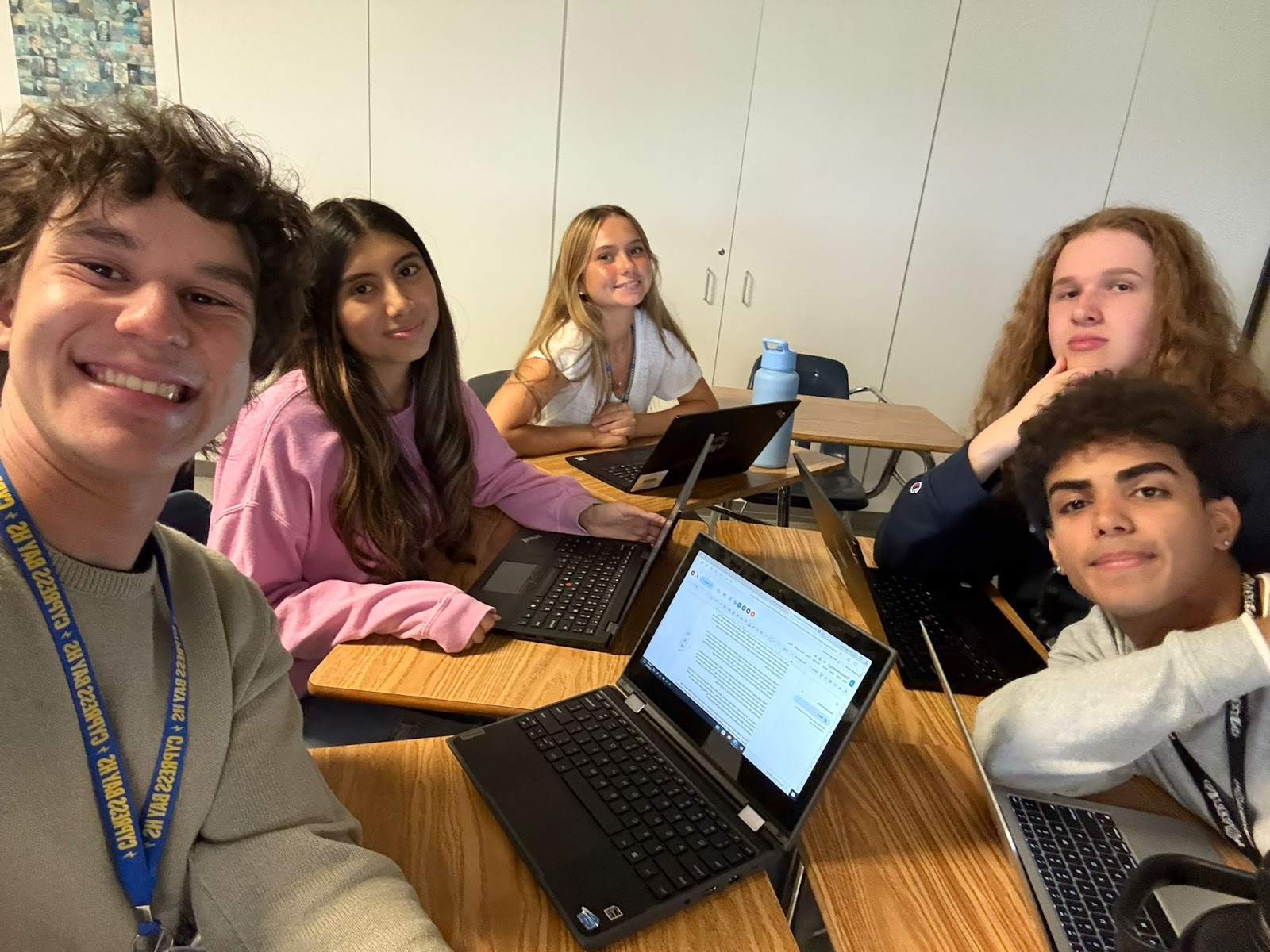
We also took a selfie at the end of the meeting! (I am on the top right)